The Glucose Ketone Index (GKI)
A single number that Seyfried calls the first biomarker of how healthy your mitochondria are - and a map of where you sit between prevention and risk.
The Glucose Ketone Index (GKI) is blood glucose divided by blood ketones, both measured in mmol/L. The lower the number, the more the body is running on ketones rather than glucose; Seyfried associates a GKI between 0.5 and 4 with cancer management.
GKI calculator
Enter your readings. Ketones are measured in mmol/L everywhere; glucose is shown in mg/dL by default (used in the US) - switch to mmol/L if that is what your meter reports. The GKI is the same either way.
Enter your glucose and ketone readings to see your GKI and zone.
How it was born
The GKI came out of a real patient: Trudy Dupont, a lawyer with a brain-stem tumour. Blood glucose on its own is volatile - one day, stressed after someone took her disabled parking spot, hers spiked to 186 mg/dL even on a ketogenic diet. Rather than track glucose and ketones separately, Seyfried and colleagues combined them into a ratio that stays stable and meaningful.
The calculation
Blood glucose (mg/dL) ÷ 18Blood ketones (mmol/L)= GKI
The ÷18 only converts glucose from mg/dL to mmol/L. If your meter already reports glucose in mmol/L (as in Lithuania and most of the world), skip that step - just divide glucose (mmol/L) by your ketone reading. Lower = deeper ketosis and (per Seyfried) healthier mitochondria.
The zones
Seyfried, with Derek Lee and Christos Chinopoulos, mapped GKI values onto a colour-coded chart - a “bioenergetic road map to health.” Lower numbers correspond to the metabolic state our ancestors lived in naturally.
- Inflammation
- Hypertension
- Obesity
- Cancer
- Metabolic syndrome
- Cardiovascular disease
- Dementia
- Neurological disorders
- Drifting toward chronic-disease risk
- Weight reduction
- Energy stabilization
- Mental health regulation
- Lean muscle preservation
- Cancer management
- Biomarker improvement
- Disease reversal
Lower GKI = deeper ketosis and better metabolic health. Enter your readings in the calculator to highlight your band.
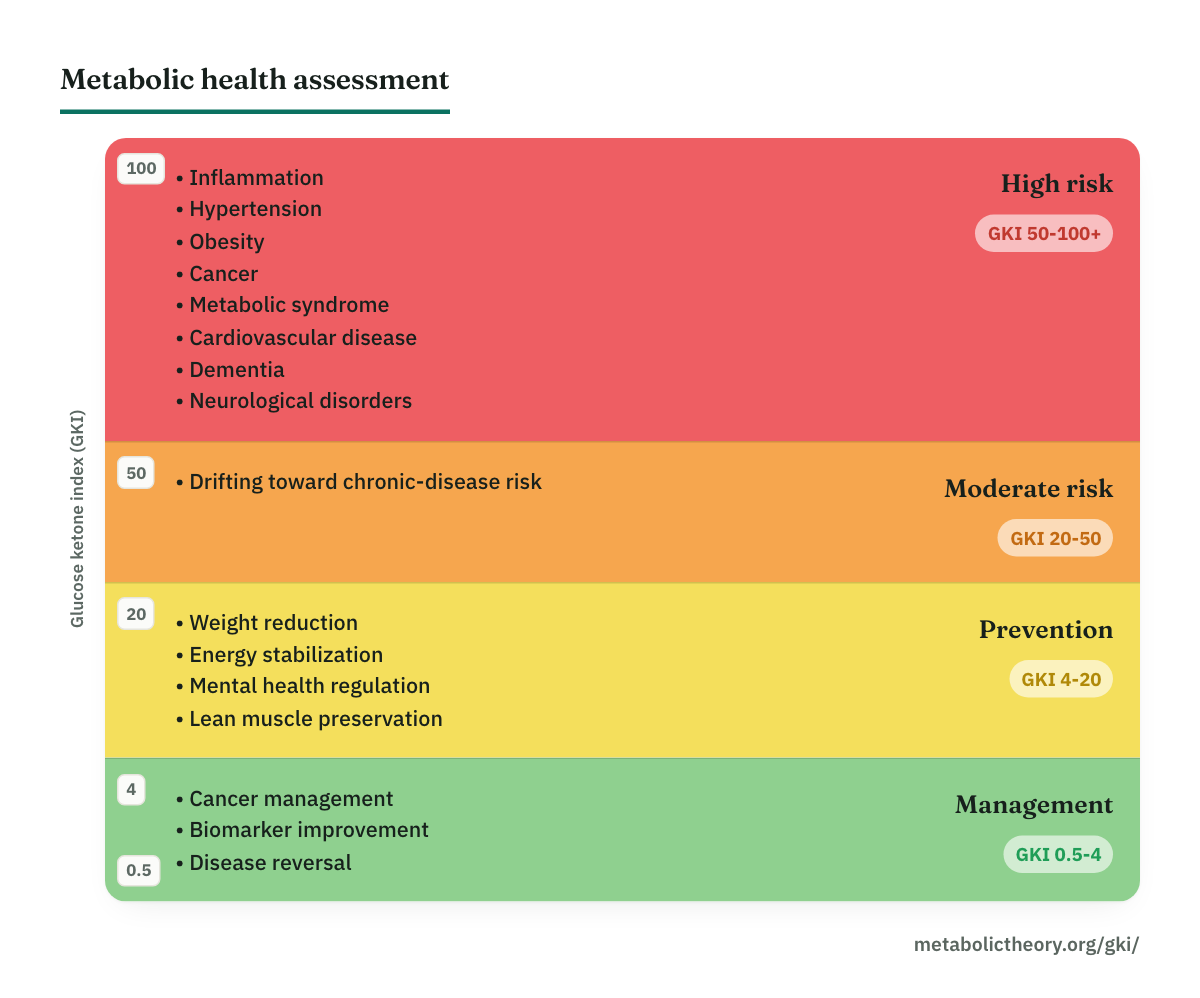 Printable chartThe same zones as a single image, to print or save.Download the chart (PNG)
Not to be confused with ketoacidosis
Nutritional ketosis (ketones ~0.4-3 mmol/L) is how humans evolved to run during scarcity. Dangerous ketoacidosis involves ketone levels of roughly 15-20 mmol/L and occurs in uncontrolled type-1 diabetes - a completely different, pathological state. Seyfried is emphatic that the two should not be conflated.
Measuring it yourself
The GKI combines two blood readings - glucose and ketones. Some meters read both from a single drop and work out the GKI for you; otherwise you take the two readings separately and divide them yourself.
What the measurement needs
This is the equipment the reading requires, whichever brand you choose.
- A meter that reads blood glucose and a meter that reads blood ketones. These can be two separate devices, or one combined meter that measures both from a single drop and often calculates the GKI itself.
- Test strips for each reading. Glucose and ketone strips are not interchangeable, and ketone strips are usually the more expensive of the two.
- A lancing device and lancets for the finger prick.
Strips are the recurring cost, so over time their price and availability where you live matter more than the price of the meter itself.
- Take a blood glucose reading and a blood ketone reading - ketones in mmol/L (urine strips will not work for the GKI).
- If your meter works out the GKI itself, you are done; otherwise divide the two readings, or use the calculator above.
- Test at the same time each day, e.g. first thing in the morning, so your readings are comparable.
Frequently asked questions
What is a good GKI reading?
On the chart above, 4-20 is the prevention zone, which Seyfried says already lowers risk for healthy people, while 0.5-4 is the zone he associates with actively managing disease. A reading of 20-50 means drifting toward chronic-disease risk, and anything above 50 is high risk.
How do you calculate the GKI?
Divide blood glucose by blood ketones, both in mmol/L. If your glucose meter reads in mg/dL, divide that number by 18 first: 90 mg/dL becomes 5 mmol/L, and with ketones at 0.4 mmol/L the GKI is 5 ÷ 0.4 = 12.5.
What does GKI stand for?
GKI stands for Glucose Ketone Index. Seyfried’s group described it in a 2015 paper as a single ratio that is steadier and easier to interpret than a glucose or ketone reading on its own.
How do I measure my GKI at home?
You need a blood glucose reading and a blood ketone reading, both from a finger prick taken at the same time. A combined meter reads both from one drop and often shows the GKI itself. Urine ketone strips will not work, because the GKI needs blood ketones in mmol/L.
Is a low GKI the same as ketoacidosis?
No. Nutritional ketosis means blood ketones of roughly 0.4-3 mmol/L. Ketoacidosis involves levels around 15-20 mmol/L, occurs in uncontrolled type-1 diabetes and is a dangerous, entirely different state. Anyone with diabetes should track their GKI together with a clinician.
Sources
- Meidenbauer JJ, Mukherjee P, Seyfried TN (2015). The glucose ketone index calculator: a simple tool to monitor therapeutic efficacy for metabolic management of brain cancer. Nutrition & Metabolism. doi:10.1186/s12986-015-0009-2
- Seyfried TN, Yu G, Maroon JC, D'Agostino DP (2017). Press-pulse: a novel therapeutic strategy for the metabolic management of cancer. Nutrition & Metabolism. doi:10.1186/s12986-017-0178-2